

A well-organized warehouse is crucial for businesses to stay competitive. By implementing efficient strategies, companies can significantly reduce picking time by 25-30% and inventory errors by 40%. This not only improves productivity but also reduces costs and enhances customer satisfaction.
An efficient warehouse layout is key to achieving these benefits. It enables easy navigation, streamlines inventory management, and ensures that products are easily accessible. By optimizing warehouse inventory management, businesses can respond quickly to customer demands, thereby improving overall customer satisfaction.
Key Takeaways
- Improve productivity with a well-organized warehouse
- Reduce costs by implementing efficient warehouse strategies
- Enhance customer satisfaction through timely order fulfillment
- Optimize warehouse layout for easy navigation
- Streamline inventory management for better control
The Importance of Warehouse Organization for Efficiency
A well-organized warehouse is crucial for businesses aiming to enhance their operational efficiency. Effective warehouse organization is not just about tidiness; it’s about creating a system that streamlines operations, reduces costs, and improves customer satisfaction.
Understanding Warehouse Logistics
Warehouse logistics involves the planning and coordination of the movement and storage of goods within a warehouse. It encompasses a range of activities, including receiving, storing, picking, packing, and shipping. Efficient logistics management is critical to ensuring that products are delivered to customers on time and in good condition.
To achieve this, warehouses must implement robust inventory management systems and utilize technology such as barcoding and scanning solutions. These tools help track inventory levels, monitor product movement, and identify areas for improvement.
The Cost of Disorganization
Disorganization in a warehouse can lead to significant financial losses. It’s estimated that disorganized warehouses contribute to $15-30 billion in annual losses due to theft, damage, and inefficiency. These costs can arise from various issues, including:
- Inaccurate inventory tracking
- Inefficient picking and packing processes
- Increased labor costs due to wasted time searching for products
- Damage to goods during storage or shipping
Benefits of an Organized Warehouse
On the other hand, an organized warehouse offers numerous benefits, including:
- Improved Efficiency: Streamlined processes reduce the time taken to receive, store, and ship products.
- Cost Savings: Reduced waste, lower labor costs, and minimized damage to goods all contribute to cost savings.
- Enhanced Customer Satisfaction: Accurate and timely order fulfillment leads to higher customer satisfaction rates.
By understanding the importance of warehouse organization and implementing efficient logistics strategies, businesses can significantly improve their operations and bottom line.
Evaluating Your Current Organization Setup
Evaluating your warehouse setup is a critical step in streamlining processes and enhancing productivity. To achieve this, it’s essential to understand the current state of your warehouse operations.
Conducting a Warehouse Assessment
A thorough warehouse assessment involves examining every aspect of your warehouse operations, from receiving and storage to shipping and inventory management. This process helps identify areas that are functioning well and those that require improvement.
To conduct an effective assessment, consider the following steps:
- Review current inventory management practices.
- Analyze the warehouse layout and storage solutions.
- Evaluate the efficiency of receiving and shipping processes.
- Assess the condition and utilization of equipment and technology.
For instance, a warehouse assessment might reveal that your current storage solutions are not optimized for your inventory, leading to inefficiencies in picking and packing processes. By identifying such bottlenecks, you can implement changes to improve overall efficiency.
Identifying Bottlenecks and Inefficiencies
Once you have conducted a thorough assessment, the next step is to identify bottlenecks and inefficiencies in your warehouse operations. Bottlenecks are points in the process where flow is restricted, causing delays or inefficiencies.
A common bottleneck in many warehouses is the receiving area, where delays can occur due to inadequate staffing or inefficient processes. To address this, consider implementing a more streamlined receiving process, such as using advanced warehouse storage solutions that facilitate quicker unloading and processing of incoming goods.
| Bottleneck Area | Potential Solution |
|---|---|
| Receiving Area | Streamlined receiving processes, advanced storage solutions |
| Inventory Management | Inventory management software, regular audits |
| Picking and Packing | Optimized warehouse layout, efficient picking strategies |
“Regular operational audits can help identify bottlenecks and potential risks in warehouse operations, enabling proactive measures to mitigate these issues.”
By understanding and addressing these bottlenecks, you can significantly improve the efficiency and productivity of your warehouse operations.
Systems and Tools for Warehouse Organization
To achieve optimal warehouse organization, businesses must leverage the latest in inventory management technology. This involves implementing a combination of systems and tools designed to streamline operations, improve accuracy, and increase efficiency.
Inventory Management Software
Inventory management software is a cornerstone of modern warehouse organization. It provides real-time inventory tracking, automates slotting recommendations, and helps in managing stock levels. By utilizing such software, warehouses can significantly reduce errors and improve their overall operational efficiency.
Key Features of Inventory Management Software:
- Real-time inventory tracking
- Automated slotting recommendations
- Stock level management
- Reporting and analytics
Barcoding and Scanning Solutions
Barcoding and scanning solutions are another critical component of an organized warehouse. These technologies enable quick and accurate tracking of inventory as it moves through the warehouse. By reducing manual data entry, barcoding and scanning solutions minimize errors and speed up the processing of inventory.
Benefits of Barcoding and Scanning:
- Improved accuracy
- Increased speed of inventory processing
- Reduced labor costs
- Enhanced inventory tracking
Mobile Technology Integration
Mobile technology integration is increasingly important in warehouse management. It allows warehouse staff to access inventory information, receive updates, and perform tasks on the go. This mobility enhances flexibility and responsiveness within the warehouse.
| Technology | Benefits | Impact on Warehouse Organization |
|---|---|---|
| Inventory Management Software | Real-time tracking, automated recommendations | Improved accuracy, reduced errors |
| Barcoding and Scanning Solutions | Quick and accurate inventory tracking | Speeds up inventory processing, reduces labor costs |
| Mobile Technology | Access to inventory information on the go | Enhances flexibility and responsiveness |
By integrating these systems and tools, warehouses can achieve a higher level of organization, leading to improved operational efficiency and reduced costs. The key is to select the technologies that best fit the specific needs of the warehouse and to implement them in a way that maximizes their benefits.
Layout Design Strategies for Optimal Space Utilization
Optimizing warehouse layout is crucial for maximizing storage capacity and efficiency. A well-designed layout not only enhances productivity but also reduces operational costs and improves overall customer satisfaction.
To achieve an optimal warehouse layout, several key principles must be considered. These include:
- Maximizing vertical space to increase storage capacity without expanding the warehouse footprint.
- Implementing an efficient aisle design to reduce travel time and improve picking productivity.
- Utilizing a logical product placement strategy to streamline picking and packing processes.
Principles of Efficient Warehouse Layout
An efficient warehouse layout is guided by several core principles. First, it’s essential to understand the flow of goods and products within the warehouse. This involves analyzing the receiving, storage, picking, and shipping processes to identify areas for improvement.
Efficient aisle design is another critical aspect. Aisles should be wide enough to accommodate equipment and personnel safely, while also minimizing wasted space. The use of dynamic slotting can further optimize aisle space by adjusting the location of products based on demand.
Vertical Space and Its Benefits
One of the most effective ways to increase storage capacity is by maximizing vertical space. By using tall shelving and racking systems, warehouses can store more products without needing to expand their footprint. This approach not only saves on real estate costs but also reduces the need for additional infrastructure.
“The use of vertical space in warehouses has become a game-changer for many businesses, allowing them to increase storage capacity without the need for costly expansions.” – Industry Expert
To effectively utilize vertical space, warehouses can implement high-bay storage systems or automated storage and retrieval systems (AS/RS). These systems enable the efficient storage and retrieval of products, even in the most densely packed environments.
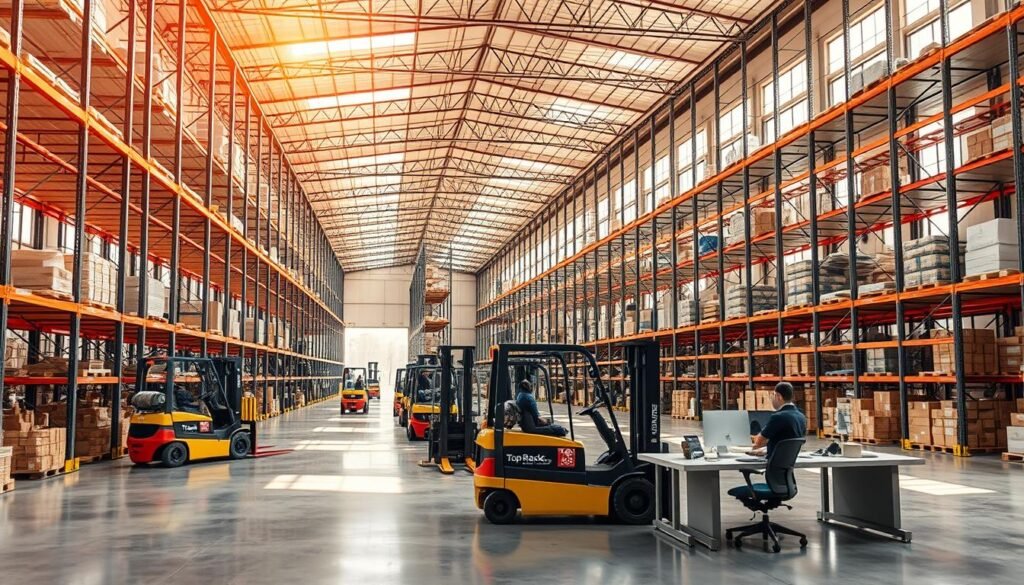
By applying these layout design strategies, warehouses can significantly enhance their operational efficiency, reduce costs, and improve customer satisfaction. Whether through optimizing aisle design or maximizing vertical space, the benefits of a well-designed warehouse layout are clear.
Best Practices for Stock Organization
Stock organization is a foundational element in achieving operational excellence in warehouses. Effective stock organization not only enhances productivity but also reduces costs associated with inventory management. By implementing best practices, warehouses can significantly improve their overall efficiency.
ABC Analysis for Inventory
ABC analysis is a widely used inventory management technique that categorizes inventory into three categories based on its value and importance. Category A includes high-value items that require close monitoring, Category B consists of moderate-value items, and Category C contains low-value items.
By applying ABC analysis, warehouses can prioritize their inventory management efforts on high-value items, thus optimizing resource allocation. For instance, Category A items might be stored in easily accessible locations to facilitate quick retrieval.
| Category | Value | Management Priority |
|---|---|---|
| A | High | High |
| B | Moderate | Medium |
| C | Low | Low |
FIFO vs. LIFO: Which is Better?
The choice between First-In-First-Out (FIFO) and Last-In-First-Out (LIFO) inventory management methods depends on the type of products being stored and the warehouse’s operational goals. FIFO is often preferred for perishable goods to minimize spoilage, while LIFO might be used for non-perishable items where the latest stock is prioritized.
For example, a warehouse storing food products would benefit from using FIFO to ensure older stock is sold or used before it expires. On the other hand, a warehouse dealing with non-perishable goods might opt for LIFO to simplify inventory management.
To further enhance stock organization, consider implementing a robust pallet racking system. Companies like Top Racks Direct offer a variety of pallet racking solutions that can be tailored to specific warehouse needs, improving storage capacity and accessibility.
Creating User-Friendly Picking Processes
A user-friendly picking process is crucial for reducing errors and increasing efficiency in warehouse operations. By implementing effective picking strategies, warehouses can significantly improve their overall productivity.
Different Picking Methods
There are several picking methods that warehouses can adopt, each with its own advantages. The most common methods include:
- Discrete Picking: This involves picking items one order at a time. It’s simple but can be time-consuming.
- Batch Picking: This method involves picking items for multiple orders simultaneously, reducing travel time.
- Zone Picking: In this method, the warehouse is divided into zones, and pickers are assigned to specific zones.
- Wave Picking: This involves releasing picking tasks in waves, often synchronized with shipping schedules.
According to a study by Supply Chain Management Review, adopting the right picking method can lead to significant improvements in efficiency. For instance, batch picking can reduce travel time by up to 50%.
Optimizing Picking Paths
Optimizing picking paths is essential for reducing travel time and improving picking efficiency. This can be achieved through:
- Analyzing the warehouse layout to identify the most efficient routes.
- Implementing a warehouse management system (WMS) that can optimize picking paths in real-time.
- Training pickers to understand the warehouse layout and the most efficient picking paths.
As noted by
“The key to optimizing picking paths is to minimize travel time while maximizing the pick rate.” –
Here’s an example of how different picking methods can impact efficiency:
| Picking Method | Travel Time Reduction | Pick Rate Improvement |
|---|---|---|
| Discrete Picking | 0% | 0% |
| Batch Picking | up to 50% | up to 30% |
| Zone Picking | up to 40% | up to 25% |
| Wave Picking | up to 30% | up to 20% |
By understanding the different picking methods and optimizing picking paths, warehouses can create user-friendly picking processes that enhance efficiency and reduce errors.
Implementing Effective Storage Solutions
To optimize warehouse space, it’s essential to implement effective storage solutions. A well-designed storage system not only enhances the overall efficiency of the warehouse but also improves safety and reduces operational costs.
Efficient Storage Solutions involve more than just storing items; they require a strategic approach to maximize space utilization. This includes assessing the types of products stored, their volume, and how frequently they are accessed.
Shelving Systems and Racking
Shelving systems and racking are fundamental components of warehouse storage. Shelving systems provide a structured way to store items, making it easier to locate and retrieve them. Racking solutions, on the other hand, are designed to maximize vertical space, allowing for more efficient use of the warehouse’s cubic space.
- Selective pallet racking for easy access to pallets
- Drive-in racking for high-density storage
- Push-back racking for last-in, first-out (LIFO) inventory management
Each of these systems has its advantages and is suited to different types of inventory and operational needs.
Custom vs. Standard Racking Solutions
When it comes to racking solutions, warehouses often face the decision between custom and standard systems. Standard racking solutions are readily available and can be cost-effective, but they may not always meet the specific needs of every warehouse.
Custom racking solutions, however, are designed to fit the unique requirements of a warehouse, including its layout, the type of products stored, and the volume of inventory. While custom solutions can be more expensive upfront, they offer long-term benefits in terms of efficiency and productivity.
For instance, a custom racking system can be designed to accommodate irregularly shaped items or to optimize storage capacity in a warehouse with unique spatial constraints.
Ultimately, the choice between custom and standard racking solutions depends on the specific needs and goals of the warehouse operation.
Streamlining Receiving and Shipping Processes
To boost warehouse productivity, it’s essential to optimize receiving and shipping operations. Efficient processes in these areas can significantly reduce handling costs and improve inventory accuracy. By streamlining receiving and shipping, warehouses can enhance their overall performance and better meet customer demands.
Efficient Receiving Procedures
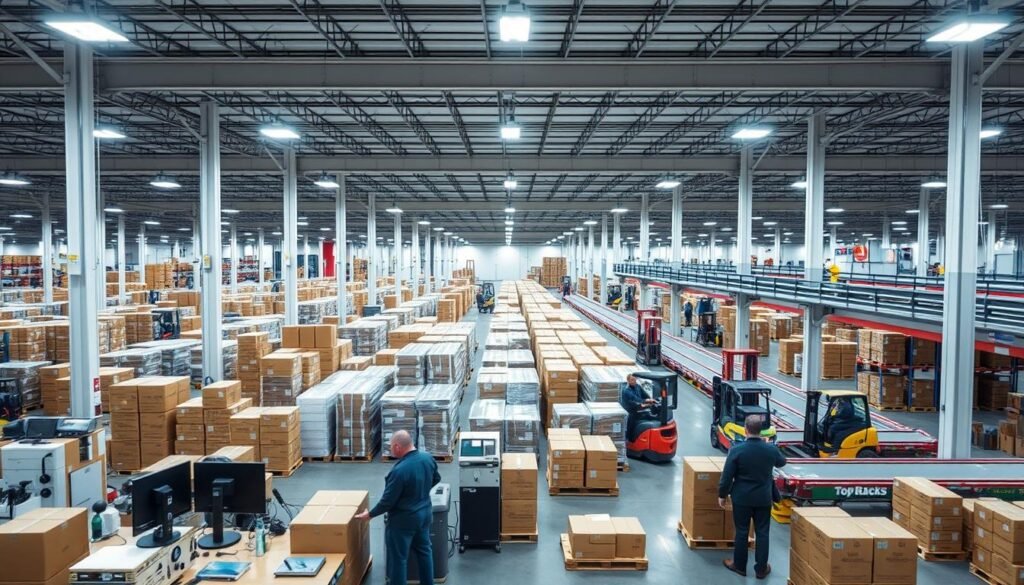
Implementing efficient receiving procedures is crucial for setting the tone for a well-organized warehouse. This involves clearly labeling and documenting all incoming shipments, ensuring that the receiving area is organized and easily accessible, and utilizing barcode scanning technology to quickly process incoming inventory.
Effective receiving procedures also include thorough inspection of shipments for damage or discrepancies and promptly reporting any issues to suppliers. By doing so, warehouses can minimize the risk of inventory discrepancies and ensure that stock levels are accurate.
Best Practices for Shipping Organization
Shipping organization is another critical aspect of warehouse management. Implementing a systematic approach to shipping can help reduce errors and increase customer satisfaction. This includes organizing shipping areas to minimize congestion and facilitate easy access to packaged orders.
- Utilize clear labeling and barcoding for all shipments to ensure accurate tracking and delivery.
- Implement a quality control check before shipping to verify order accuracy and detect any potential issues.
- Optimize shipping routes and schedules to reduce transit times and lower transportation costs.
By adopting these best practices, warehouses can enhance their shipping operations, leading to improved customer satisfaction and loyalty.
Training Staff for Better Warehouse Organization
The backbone of a well-organized warehouse is its trained personnel. In the fast-paced environment of a warehouse, the efficiency and accuracy of operations heavily rely on the skills and knowledge of the staff. Employee training is not just a necessity; it’s an investment in the productivity and safety of the warehouse.
Effective training programs can significantly reduce errors, improve picking and packing times, and enhance overall warehouse organization. As noted by a logistics expert,
“Training is the foundation upon which all other improvements are built.”
This underscores the importance of prioritizing employee training in warehouse management.
Importance of Employee Training
Employee training is crucial for several reasons. Firstly, it ensures that staff are aware of the best practices and procedures for handling inventory, managing storage, and optimizing picking routes. This not only improves efficiency but also reduces the risk of accidents and injuries. Moreover, well-trained employees are more adaptable to changes in warehouse operations, such as the introduction of new technology or systems.
Training Methods and Tools
There are various methods and tools available for training warehouse staff. These include on-the-job training, workshops, e-learning modules, and simulation training. The choice of method depends on the specific needs of the warehouse and the preferences of the staff. For instance, e-learning modules can be particularly effective for training staff on inventory management software or safety procedures.
Some of the key tools for training include:
- Inventory management software with training modes
- Virtual reality (VR) for simulation training
- Mobile apps for on-the-go learning
By leveraging these training methods and tools, warehouses can ensure that their staff are equipped to maintain a high level of organization and efficiency. As warehouses continue to evolve, ongoing training and development will remain critical to their success.
Continuous Improvement in Warehouse Management
In the fast-paced world of logistics, continuous improvement in warehouse management is not just beneficial, it’s essential. Warehouses are the backbone of supply chains, and their efficiency directly impacts the overall performance of businesses.
To achieve and maintain high levels of efficiency, warehouses must adopt a culture of continuous improvement. This involves regularly assessing operations, identifying areas for improvement, and implementing changes to enhance performance.
Establishing KPIs for Performance Measurement
One of the key steps in continuous improvement is establishing Key Performance Indicators (KPIs) that accurately measure warehouse performance. KPIs provide insights into operational efficiency, helping managers identify bottlenecks and areas that require improvement.
Some essential KPIs for warehouse management include:
- Order fulfillment rate
- Inventory turnover
- Warehouse capacity utilization
- Picking and packing accuracy
- Shipping and receiving productivity
By tracking these KPIs, warehouse managers can make data-driven decisions to optimize operations and improve overall performance.
Regular Review and Strategy Adjustment
Continuous improvement is an ongoing process that requires regular review and adjustment of strategies. Warehouse managers should periodically assess their KPIs to identify trends and areas for improvement.
This involves:
- Analyzing KPI data to identify bottlenecks and inefficiencies
- Adjusting warehouse layouts, processes, and procedures as needed
- Implementing new technologies or systems to enhance performance
- Providing ongoing training to staff to ensure they have the skills needed to support continuous improvement
By adopting a culture of continuous improvement and regularly reviewing and adjusting strategies, warehouses can achieve significant gains in efficiency and productivity.
Real-World Success Stories in Warehouse Organization
Efficient warehouse organization is not just a theoretical concept; it’s a reality for many leading companies. By examining success stories and case studies, businesses can gain valuable insights into effective strategies and lean practices that have been successfully implemented.
Amazon’s Efficiency Model
Amazon is a prime example of a company that has mastered warehouse efficiency. By leveraging advanced inventory management systems, optimizing warehouse layouts, and implementing efficient picking processes, Amazon has set a high standard for warehouse organization. Other companies can learn from Amazon’s approach to achieving high productivity and reducing costs.
Adopting Lean Practices
Companies adopting lean practices have also seen significant improvements in their warehouse operations. By eliminating waste, streamlining processes, and focusing on continuous improvement, these businesses have achieved greater efficiency and reduced costs. Examining these success stories can provide valuable lessons for other organizations looking to enhance their warehouse organization.